
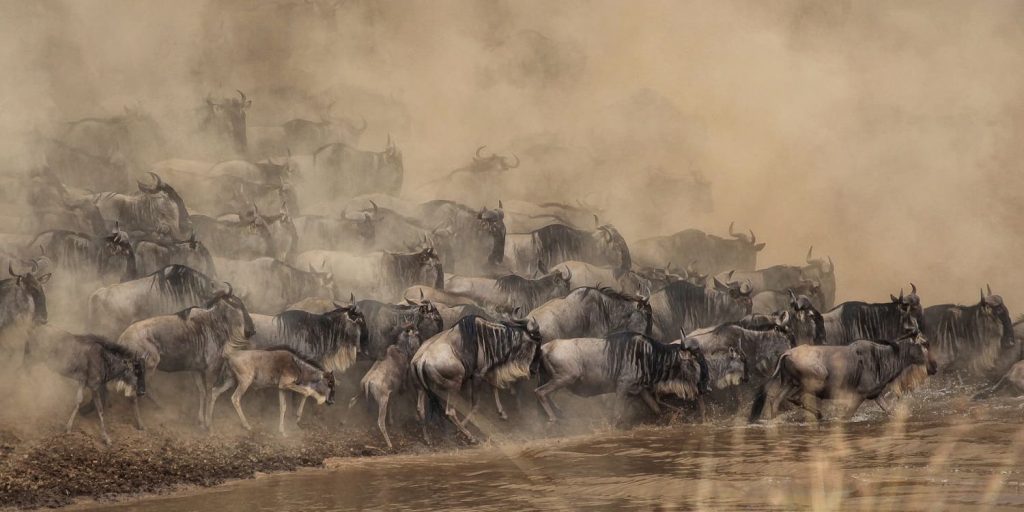
The Great Migration is the movement of over a million wildebeest from Tanzania’s Serengeti to Kenya’s Masai Mara. It is one of the world’s most spectacular wildlife events, showcasing thrilling animal behavior. The migration occurs annually, guided by instincts and rainfall patterns across the Serengeti-Maasai Mara ecosystem. For the 2021 and 2022 seasons, we recommend planning travel from mid-July, when large herds start entering the Masai Mara. The Great migration takes place till end of August, before declining into mid September.
Although numbers vary yearly, past migrations have included up to 1.5 million wildebeest on the long trek. Their journey is especially dangerous when crossing the crocodile-infested Mara and Talek rivers, where giant Nile crocodiles lie in wait for prey.
A Guide to the Great Migration
Travelers planning a Kenyan safari often have many questions about the great migration. Below, we list the most common for clarity.
What time of the Year is the Great Migration ?
The great migration into the Masai Mara usually begins in July and ends in late September, but exact dates of the great migration vary. Large wildebeest herds first gather at Serengeti’s northern edge near the Mara, sometimes waiting for days before crossing. This makes it difficult to predict the precise start of the final movement.
So what is the best time to visit Masai Mara to see the Migration ?
Based on decades of experience, mid-July to late August is the best time to witness the great migration. It is a gradual event spread over several weeks along the Serengeti-Masai Mara border. If narrowed to a single month, August offers the most remarkable sightings.
Where do the wildebeest migrate to and from ?
The wildebeest move from the Serengeti into the Masai Mara, guided by climate, pasture, and breeding seasons. Their great migration follows a year-round clockwise path across Serengeti, before reaching the Masai Mara around July to August. Their journey back to Serengeti happens around late October though this is less spectacular and more like a slow dispersal.
How do you see the Great Migration ?
You can witness the great migration on a game drive in the Masai Mara, conducted in specialized vehicles with experienced guides. Since river crossings occur at key points, it may be necessary to position yourself there during a full-day outing. Some lodges and camps are up to an hour’s drive from the best vantage spots.
Most tourists visiting for the great migration consider river crossings the highlight of their great migration safari. They often spend extended time at these points, which shift slightly each year but remain within the same general areas of the reserve.
Book with Kairi Travels Today
Month by Month Wildebeest Migration
Many people believe the Great Migration happens only once a year, but it is actually a year-round phenomenon. Different stages offer unique and exciting wildlife experiences throughout the year. The river crossings, often the most requested event, usually align with peak safari season, leading to the misconception that this is the only time wildebeest are on the move.
This crossing usually happens at the Mara River from late July to August, sometimes into September, and again during the return south from late October to early November. Hence, the best times to track and see the annual wildebeest migration in Masai Mara. Below is a general breakdown of where the herds are throughout the year. Keep in mind their movements are hard to predict, as rainfall—whether early, late, or on time—guides their journey..
December to April
The predator interaction is also most likely, as the lions and leopards are moving to this region to prey on the young and vulnerable calves. End of March/early April the herds move slowly and predictably to begin their northward journey, and many have left already and are in the central and even western Serengeti.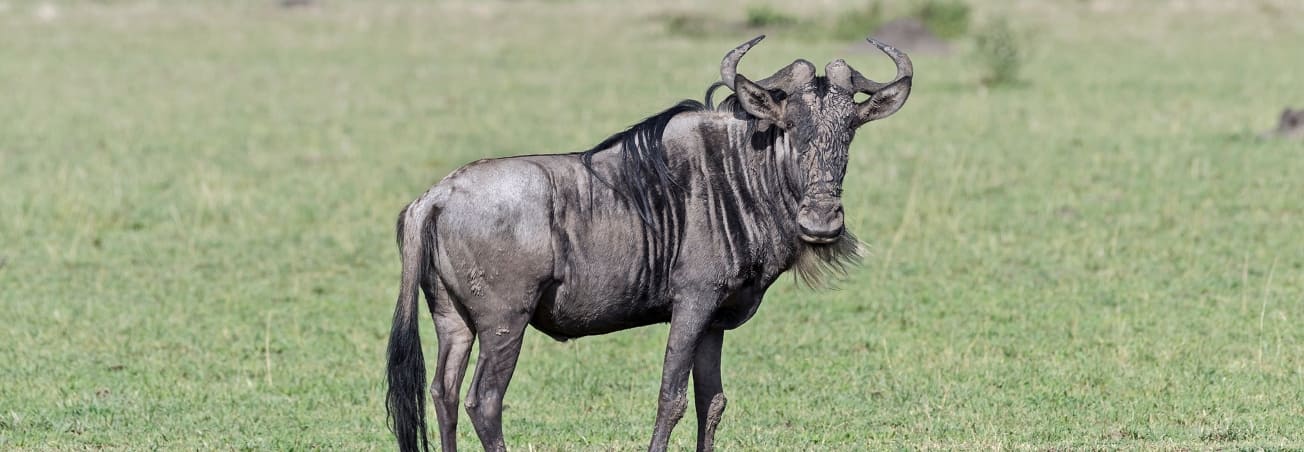 Wildebeest in Ndutu plains, Serengeti during the great migration
Depending on the rains, the herds can be seen south of Serengeti National Park between Ndutu plains and Ngorongoro plains. Hence, the best place to be during these four months is the far south of Serengeti. Around February, it is the calving season and there are high chances of witnessing a wildebeest birth. The herds move swiftly, in search of favorable grasslands to provide sustenance for the arrival of their young.
May to June
During this time of the year the migratory herds all seem to be moving north, in search of fresh grazing and water. The great migration is usually in huge columns of up to 40 kilometres / 25 miles in length can be sometimes be seen as the wildebeest funnel up into the central and western Serengeti, often containing hundreds of thousands of animals – joined by many zebra, and a scattering of Thomson’s and Grant’s gazelles.
June marks the end of rainy season, traditionally this is the Grumeti River crossing period, but this is mainly dependent on water level of the Grumeti River ( here you may spot Nile Crocodiles). This crossing is not quite as spectacular as the crossings of the Mara River.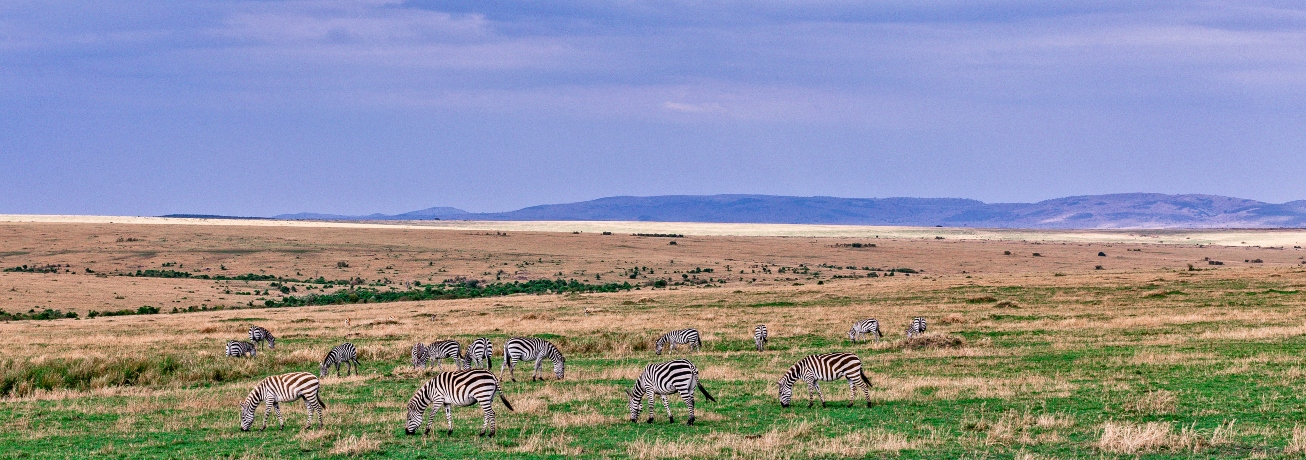 Wildlife in Serengeti National Park
July to September
This is when the big event occurs, the start of major Mara River crossing. The herds have reached the western Serengeti and Grumeti Reserves and are peering closely at the brown waters of the rivers they have to cross. In August, the survivors herd continues moving northwards, into the northern Serengeti and begin crossing into Kenya’s Masai Mara National Reserve.
The herd breaks into smaller groups- almost half of the animals remains in the northern Serengeti, the rest of the wildebeest will have crossed the Mara River, and the majority of the herds will be in the Greater Masai Mara area, eating the lush green grass resources before venturing north towards the private conservancies (Mara North, Olare Orok).This is usually the most preferred moments of the great migration, watching the frantic herds of the wildebeests crossing the Mara River.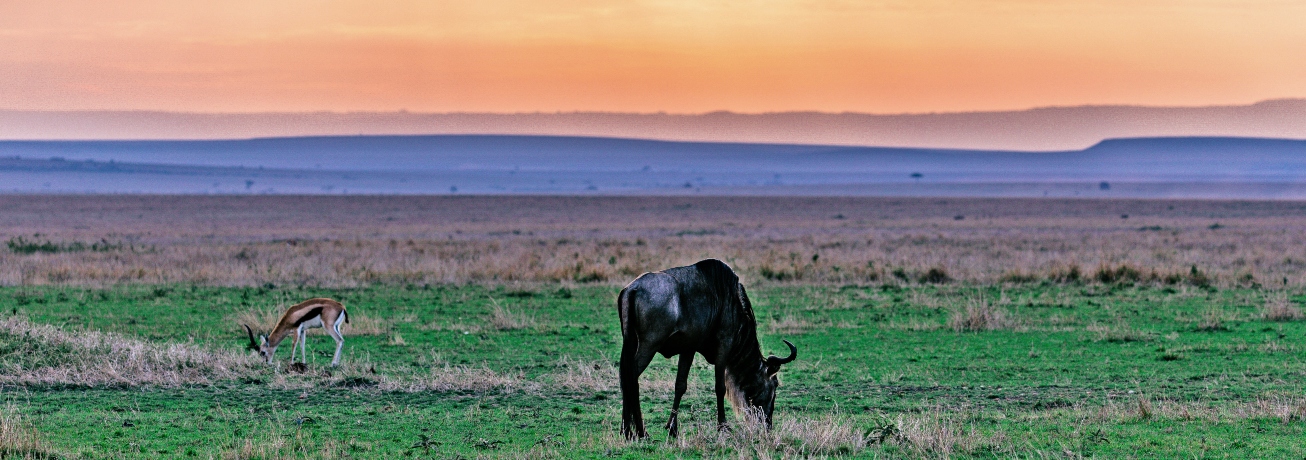 Wildebeest
October to November
The wildebeest herds are migrating again with more accord: all are heading south, through western Loliondo and the Serengeti National Park’s Lobo area, returning to the green shoots. The herds can now be seen in Kogatende and Lamai (Northern Serengeti). In a ‘normal year’ the short rains have begun in November. The herds are now in the Serengeti, stationed in the Lobo, Mbuze Mawe and Seronera Valley areas where water is abundant. Fresh grazing sees the wildebeest clustered in the north-eastern Serengeti (around Lobo in particular) as well as the southern Serengeti. Calving begins again, the predators move in again, and the cycle of life begins all over again.
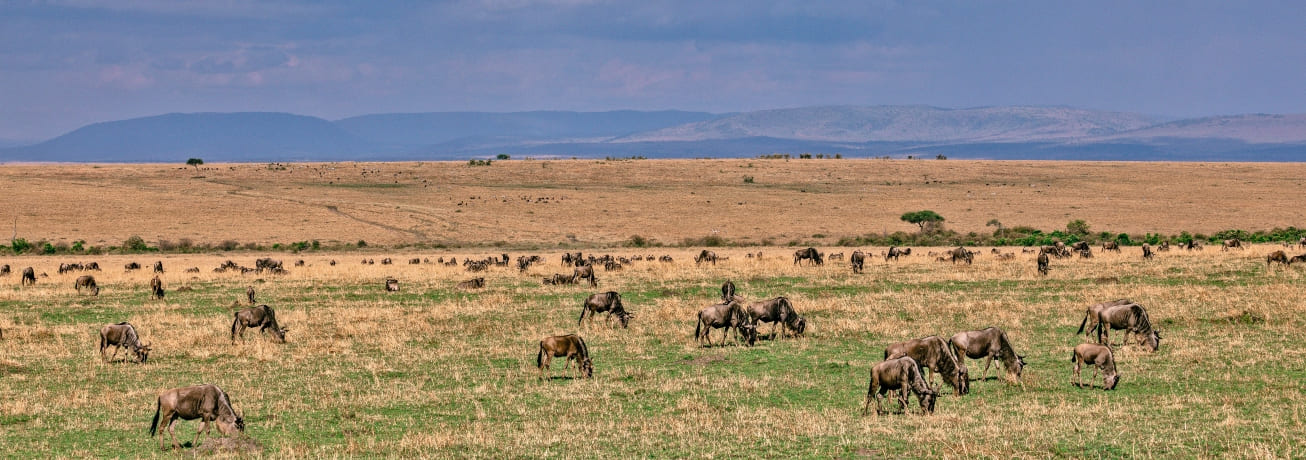 Wildebeest in Masai Mara
