
Each year, the vast plains of East Africa host one of nature’s most staggering spectacles: the Great Migration Kenya . This isn’t just a trek; it’s a life-and-death pilgrimage involving 1.4 million wildebeest and hundreds of thousands of zebras and gazelles. For travelers on a private African safari, witnessing the Great Migration Kenya is a rare chance to see nature’s rawest drama—from the tension of a river crossing to the quiet vulnerability of a newborn calf.
While many think of the Great Migration Kenya as a single event, it is actually a year-round circular journey. If you are planning to see this “World Cup of Wildlife,” integrating it into your Masai Mara Safari Packages is the most effective way to ensure you are in the right place at the right time.
How Does the Great Migration in Africa Work?
Wildlife completes a relentless clockwise circuit between Tanzania’s Serengeti and Kenya’s Masai Mara. However, as Great Migration Kenya expert Richard Knocker explains, this is often oversimplified: “The Migration is not a continuous forward motion. They go forward, backwards, and to the sides… You can never predict with certainty where wildlife will be.”
The movement is driven entirely by localized weather, standing water, and the search for fresh grazing grounds. Generally, the herds move from the southern Serengeti, through the Western Corridor, and up into the Masai Mara, before closing the loop by heading back south.
Where to See the Great Africa Kenya Migration
During the Great Migration, herds travel about 1,200 miles between Tanzania and Kenya as they pursue fresh grazing grounds and reliable water.
“Disregard any pretty map you may have been shown that has a tidy flow of animals going round in an annual circle,” cautions Richard. “The Migration does not work like this. It is driven entirely by standing water, grazing and created by local weather conditions.”
Still, there are some guidelines for when and where to visit.
Generally speaking, the Great Migration is observed as moving from Tanzania’s southern Serengeti, north through the Western Corridor and up to the Maasai Mara. The animals close the loop, arriving back at their southern Serengeti calving grounds via the Lobo Area or Loliondo Game Controlled Area in Tanzania.
When is the Best Time to See Africa’s Great Migration Kenya?
A cheetah walks in the short grass plains in front of vigilant wildebeest.
“They will leave this area as late as possible and come back as soon as they can,” Richard explains. “This means that every year is different. In fact, every week can be different.” Typically, the first animals start setting out in April. Over the following months, they’ll navigate countless obstacles, from predators to river crossings. Here’s a breakdown of their tentative travel schedule, so you can plan your own Great Migration journey.
The Great Migration Kenya in December Through April
From December to April, the wildebeest prefer the short, grassy plains of the southern Serengeti where the cropped vegetation offers predators less cover. Depending on localized rainfall, herds can be seen anywhere from the Moru Kopjes of the Central Serengeti to the slopes of the Ngorongoro Crater in the south.
“Within a relatively short space of time, perhaps four to six weeks, several hundred thousand calves will be born,” says Richard, “This is when we see much of the dramatic predator action.” Most of the calves arrive in February and March.
Fun Fact: Within 10 minutes of birth, wildebeest are standing on their feet. They may be wobbly, but they’re born ready to run when the herd decides to head out. If travelers are hoping to see newborn calves or if predatory action is a Great Migration Kenya priority, February and March are the recommended months of travel.

The Migration in May and June
Once the rainy season is over, the south and east plains of the Serengeti dry out, prompting the beginning of the Great Migration Kenya. This usually starts in April or May when herds begin to move north and west, although not always as one cohesive group. “Not all the wildebeest and zebra will follow the same route,” Richard points out. This period is a transition, a mass movement toward the Masai Mara Safari Packages territories where the permanent water sources await.
The Great Migration Kenya July Through November
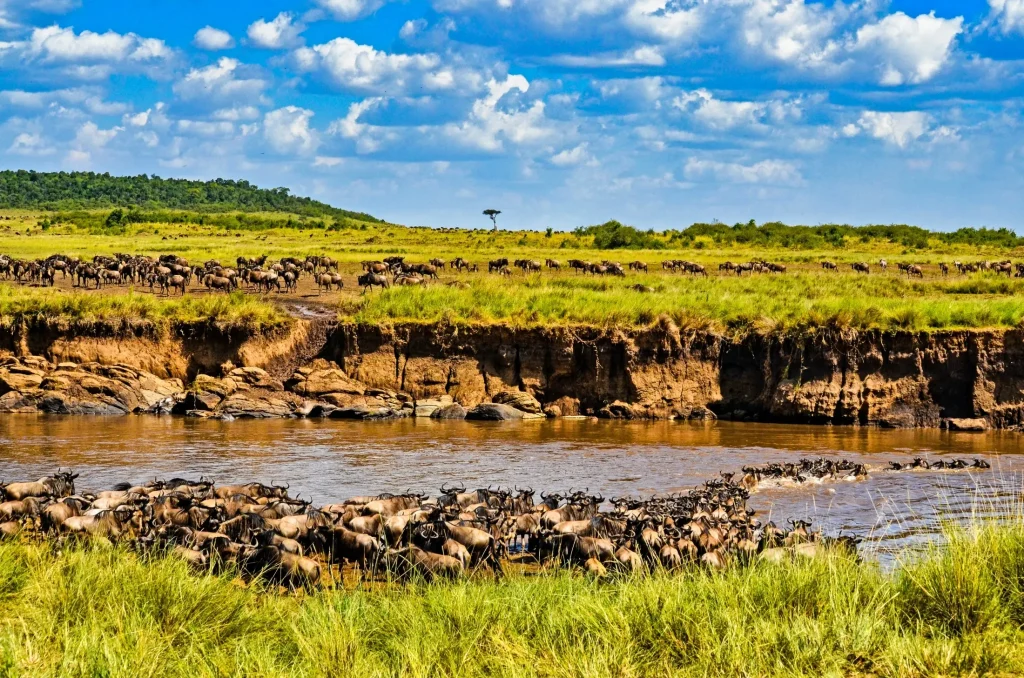
July through November is traditionally considered the best time to view the Great Migration. Between July and August, the wildebeest move en masse into Kenya’s Masai Mara, crossing the Mara River in staggering numbers. For travelers, river crossings rank among the most sought-after moments of the Great Migration Kenya.
“The wildebeest are easily spooked by real or imagined threats. They fear crossing the river, as they have an inkling that something lurks there,” Richard describes. “Patiently waiting near a herd may only produce a puff of dust as they turn on their heels and run away. Or maybe the herd is not ready to cross the river and they are milling around contentedly.”
In a dry year, the first wildebeest can reach the Mara River (the only decent, permanent source of water in the ecosystem) as soon as early July; in a wet year, it may be as late as mid-August. If the cacophony of anxious wildebeest making a perilous river crossing tops your safari bucket list, plan your Great Migration Kenya trip for the summer. However, it is important to acknowledge that July, August, and September represent peak travel season. In order to secure your preferred lodgings and operator, you will want to book 12 to 18 months out.
The Great Migration Kenya in October and November
It’s not over yet! Remember, the Great Migration is fluid and enduring. In the fall, the herds start to work their way south into Tanzania, so there will be plenty of wildlife spotting in popular safari destinations like Kenya’s southern Masai Mara and in northern Tanzania.
“The Great Migration as a whole need not all pass into Kenya, and many stay behind or cross and re-cross the border areas. This carries on until October and November when they will start thinking of heading back. Again, this will be dependent on the rains,” explains Richard.ey will start thinking of heading back. Again, this will be dependent on the rains,” explains Richard.
How to Experience the Great Migration with Kairi Travels

When tracking the Great Migration, you have two main options for your stay:
- Permanent Safari Camps: These offer luxury amenities and year-round comfort, relying on game drives to reach the herds.
- Mobile Safari Camps: These move two or three times a year to stay in the heart of the Great Migration pattern, prioritizing proximity to the animals above all else.
Choosing between the two involves weighing comfort against the desire to be “in the thick of it.” Whether you are looking for a quick 3 Days Masai Mara Safari or a comprehensive Wildlife Safari Adventure, our specialists can help you position yourself perfectly for the 2026 season.
